




Research Report

State of
Brain Emulation
2025

A comprehensive assessment of 20 years of progress in neural recording, connectomics, and computational neuroscience.

"It is hard to pinpoint numbers, but as of 2025 we estimate that less than 500 people globally are actively dedicated to the direct objectives of brain emulation. [...]

Such a small community means that every individual contributor's presence or absence can profoundly shape the field's trajectory. We hope this report will serve to attract new talent to this emerging and interdisciplinary endeavor."

— Preface, State of Brain Emulation Report 2025

Authors

Niccolo Zanichelli, Maximilian Schons, Isaak Freeman, Philip K. Shiu, Anton Arkhipov

With contributions from:

Adam Glaser, Adam Marblestone, Anders Sandberg, Andrew Payne, Andy McKenzie, Anshul Kashyap, Camille Mitchell, Christian Larsen, Claire Wang, Connor Flexman, Daniel Leible, Davi Bock, Davy Deng, Ed Boyden, Florian Engert, Glenn Clayton, James Lin, Jianfeng Feng, Jordan Matelsky, Ken Hayworth, Kevin Esvelt, Konrad Kording, Lei Ma, Logan Thrasher Collins, Michael Andregg, Michael Skuhersky, MichaƂ Januszewski, Nicolas Patzlaff, Niko McCarty, Oliver Evans, Ons M'Saad, Patrick Mineault, Quilee Simeon, Richie Kohman, Srinivas Turaga, Tomaso Poggio, Viren Jain, Yangning Lu, Zeguan Wang

View all contributors →
Content Preview

Executive Summary

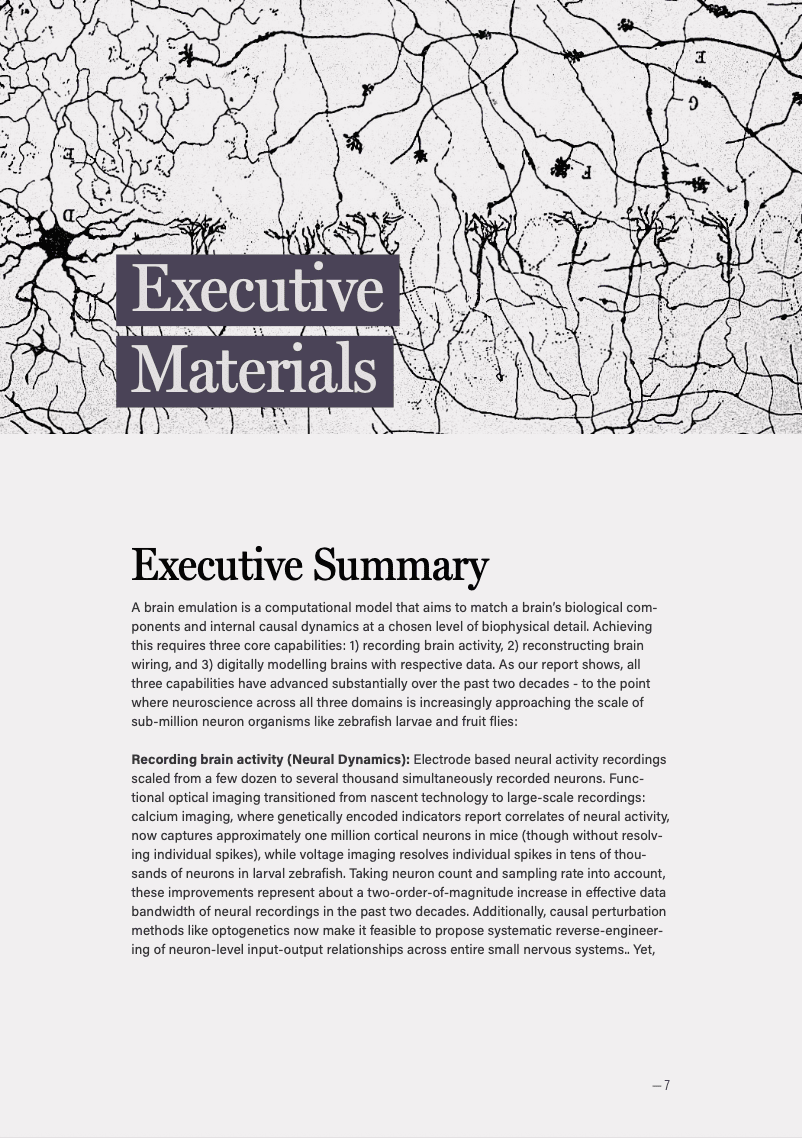
A brain emulation is a computational model that aims to match a brain's biological components and internal, causal dynamics at a chosen level of biophysical detail.

Understanding how the brain works remains one of humanity's greatest scientific challenges, with profound implications for medicine, artificial intelligence, and our understanding of consciousness itself. Building a brain emulation requires three core capabilities: 1) recording brain activity, 2) reconstructing brain wiring, and 3) digitally modelling brains with respective data. In this report, we explain how all three capabilities have advanced substantially over the past two decades, to the point where neuroscientists are collecting enough data to emulate the brains of sub-million neuron organisms, such as zebrafish larvae and fruit flies.

Brain emulation pipeline overview

Technical Overview

Recording Brain Activity — Neural Dynamics

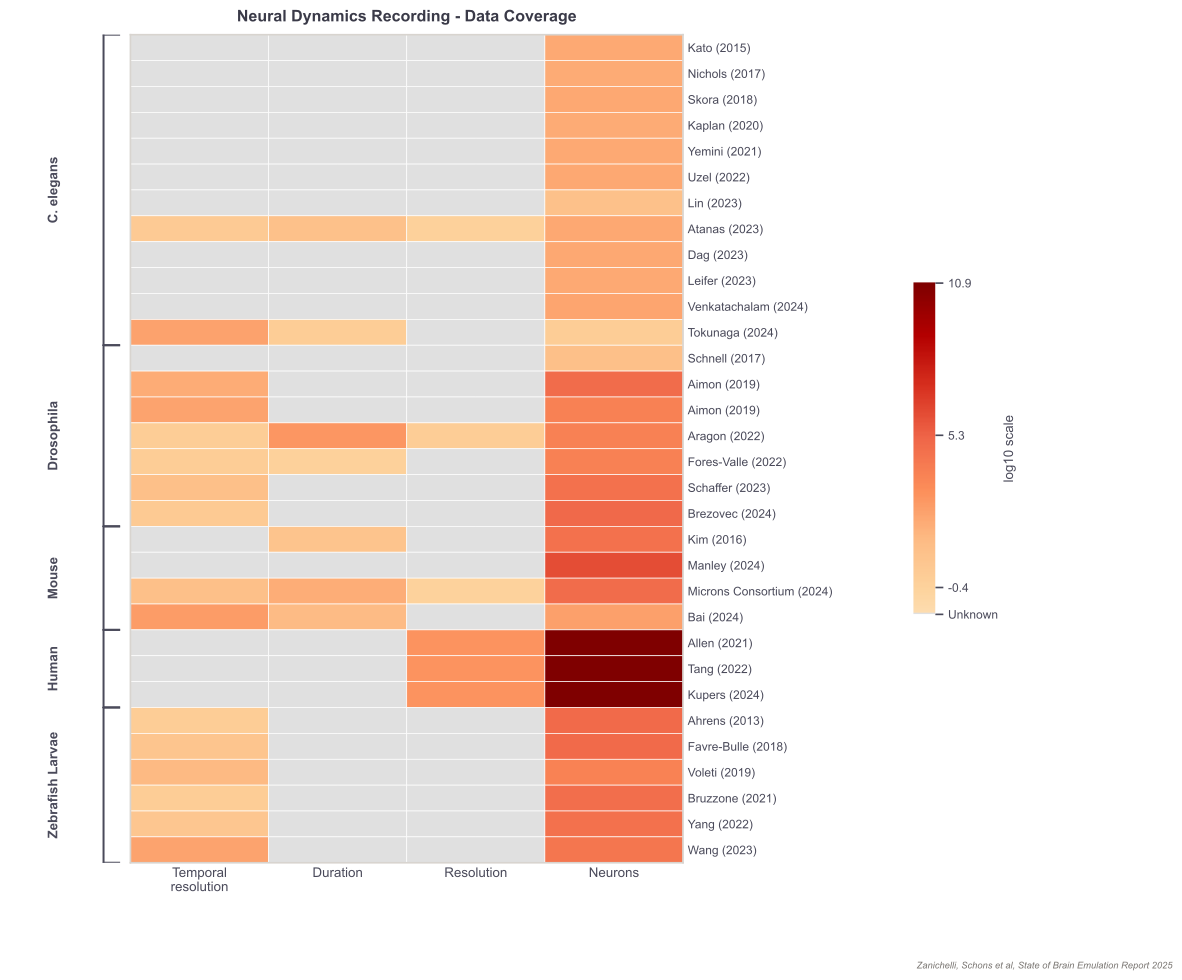
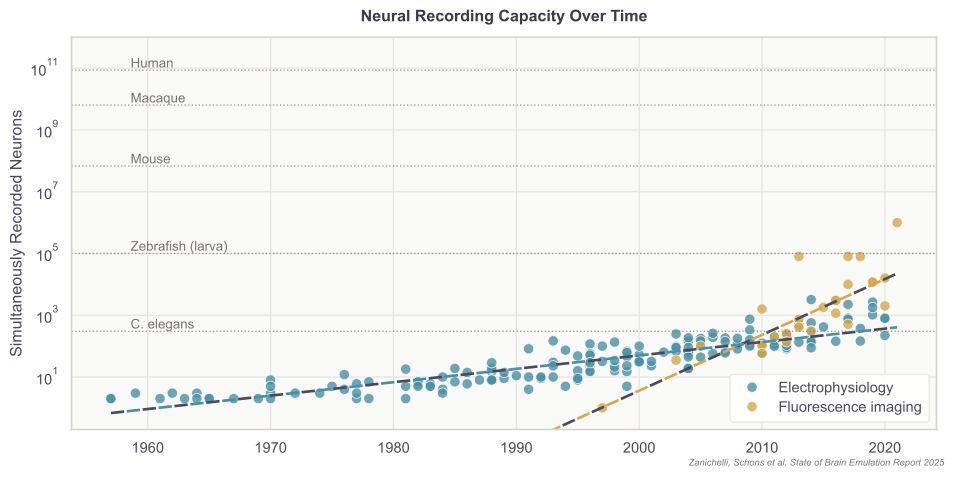
Despite impressive progress in neuron recording capabilities, neuroscience has not yet achieved whole-brain recording (≥ 95% of neurons and brain volume) at single-neuron resolution in any organism. The closest achievements include larval zebrafish with approximately 80% brain coverage and C. elegans with roughly 50% of nervous system neurons recorded at single-cell resolution.

Even these figures come with substantial limitations: temporal resolution is typically well below neuronal firing rates (often 1-30 Hz for calcium imaging), recording durations remain short (minutes to hours), and the need for head-fixation severely constrains behavior repertoires. In larger organisms like mice, recordings focus on cortical regions or specific brain areas rather than whole-brain coverage.

Neural recording capabilities across organisms

Reconstructing Brain Wiring — Connectomics

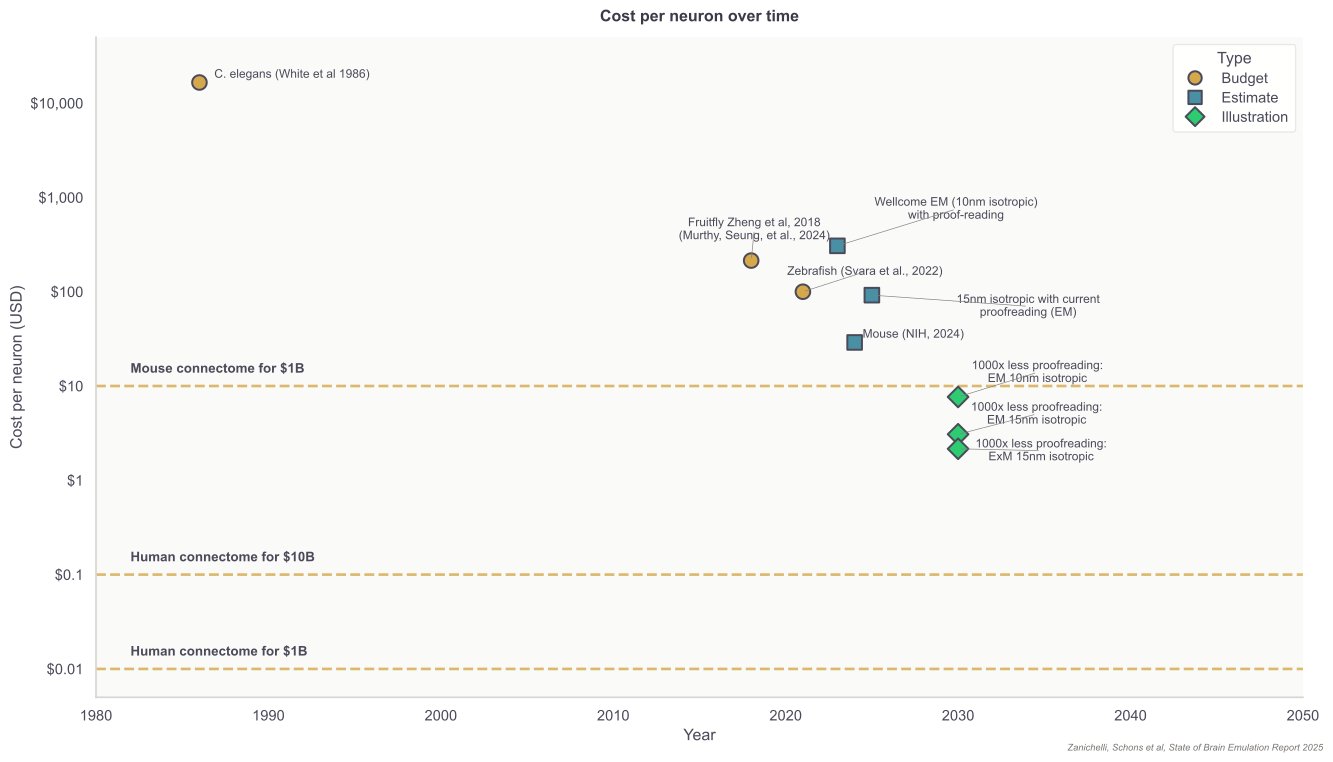
Complete connectomes at synaptic resolution currently exist only for small organisms. C. elegans has multiple whole-nervous-system reconstructions from individual specimens, with approximately ten datasets available. Adult Drosophila has fully proofread connectomes for both the male central nervous system and the female brain.

For larger organisms, progress remains at the proof-of-concept stage. In mice, the largest densely reconstructed volume is a cubic millimeter of visual cortex, containing approximately 120,000 neurons and 523 million automatically detected synapses. In humans, the largest synaptic-resolution volume is approximately 1 mm³ of the temporal cortex (0.00007% of the whole brain).

Cost per quality-controlled reconstructed neuron

Modelling Brains Faithfully — Computational Neuroscience

Meaningful progress toward whole-brain emulation is currently confined to small organisms where comprehensive datasets are becoming available. In C. elegans, multi-scale, closed-loop simulations now reproduce basic behaviors by integrating neural dynamics, body mechanics, and environmental interaction.

For Drosophila, the adult connectome has enabled models spanning the entire brain, successfully predicting neural responses and circuit functions for behaviors like feeding and grooming. In larger organisms like mice and humans, comprehensive emulation remains at the proof-of-concept stage, demonstrating building biophysically detailed cortical circuits or running human-scale simulations on supercomputers as feasibility tests.

Neural recording capabilities heatmap

Part 1: Foundations

Introduction

Brain emulation aims to computationally replicate neural dynamics, from perception to decision-making. This requires three integrated capabilities: recording brain function in vivo, mapping brain structure ex vivo through connectomics, and instantiating accurate models in silico. The report examines progress across five model organisms, focusing on electrical activity at single-neuron resolution, synaptic connectivity, and the computational frameworks needed to integrate this data.

Definitions

Key terminological distinctions for the report. A simulation matches a target system's outputs without necessarily reproducing internal causal dynamics; an emulation matches outputs by implementing the same internal dynamics at a chosen biophysical level. A minimal brain emulation must cover approximately all neurons, be constrained by an accurate synaptic-level connectome, model cell type diversity, use at least point neurons, and operate at the timescale of neuronal spiking. "Whole brain" is defined as incorporating at least 95% of neurons across 95% of brain volume.

Part 2: State of Brain Emulation across Organisms

Detailed assessments of progress toward brain emulation in each of five model organisms, examining neural dynamics recording capabilities, connectomics status, computational modeling efforts, and remaining gaps.

The report analyzes brain emulation progress across five primary model organisms, representing the systems that have driven most research relevant to whole-brain emulation.

C. elegans Adult
~300 neurons ~6,200 synapses 0.002 mm³
Zebrafish Larvae 5-7 dpf
~100K neurons Synapses TBD 0.08 mm³
Fruit Fly Adult Drosophila
~140K neurons ~50M synapses 0.04 mm³
Mouse Adult
~70M neurons ~500M syn/mm³ 420-460 mm³
Human Adult
~86B neurons Synapses TBD 1-1.5M mm³

Part 3: Methods for Brain Emulation

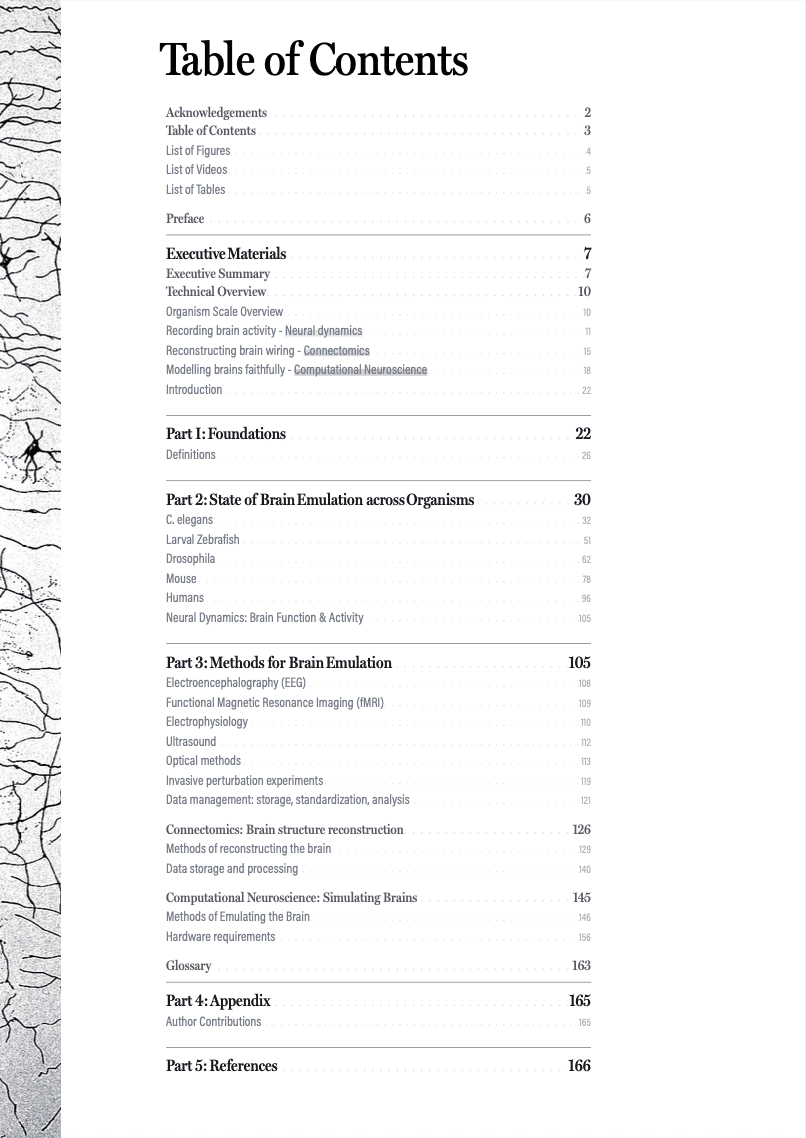
Detailed technical chapters on methodologies across the three core capabilities.

Neural Dynamics: Brain Function & Activity

Methods for recording neural activity include EEG (millisecond temporal but poor spatial resolution), fMRI (whole-brain but indirect and slow), electrophysiology with Neuropixels probes (spike-resolution but sparse sampling), functional ultrasound (sub-100 μm in rodents), and optical methods like calcium/voltage imaging with two-photon or light-sheet microscopy (large-scale but depth-limited). Optogenetics enables precise perturbation experiments to map causal relationships. Neural data repositories are growing rapidly, with initiatives like BIDS and NWB promoting standardization.

Connectomics: Brain Structure Reconstruction

Electron microscopy remains the primary modality for synaptic-resolution imaging, with multi-beam systems parallelizing acquisition and AI dramatically reducing segmentation costs. Alternative approaches include expansion microscopy (enabling molecular annotation) and X-ray microscopy (faster imaging of thicker sections). Dataset sizes now reach petabytes—a mouse brain at 10nm requires ~0.5 exabytes, a human brain ~1-1.4 zettabytes. Automated proofreading remains the cost bottleneck, though recent AI methods have improved error rates by an order of magnitude.

Computational Neuroscience: Simulating Brains

Models span multiple levels of abstraction, from simple integrate-and-fire neurons to biophysically detailed multi-compartment models. Connectome-constrained models use structural data to define network architecture, while data-driven approaches fit parameters to functional recordings. Simulating mammalian brains requires substantial resources: a mouse brain needs ~1-2 TB memory and ~5-10 PFLOP/s; human-scale requires ~1-3 PB memory and ~10 EFLOP/s. Memory capacity and interconnect bandwidth are now the primary bottlenecks.

Part 4: Appendix

Statement on AI use: We used large language models (ChatGPT GPT-4/5, Google Gemini 2.5 Pro, and Anthropic Claude 3.7/4/4.5) to assist with literature search and summarization, to generate sections of the initial draft text, and for data extraction from papers. All AI-generated content was thoroughly reviewed, verified, and edited by the authors, who take full responsibility for the final content.

Competing Interests: Philip Shiu is an equity holder in Eon Systems PBC. Maximilian Schons is the owner of MxSchons GmbH, which coordinated this project and administered funds for the authors.

References

Complete bibliography of scientific literature cited throughout the report, covering foundational works in neuroscience, recent technical advances, and key datasets.

View full list of references →

Figures & Data

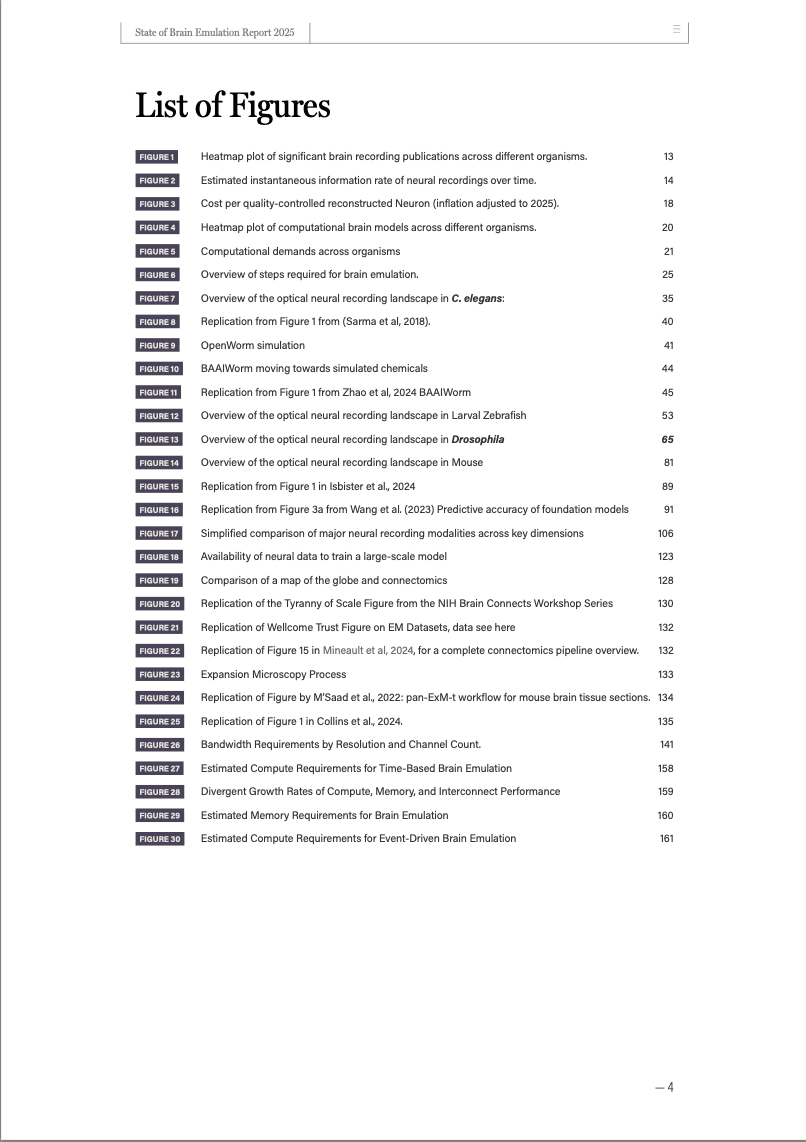
All figures from the report are available in the figure library, and underlying data is available in our public repository.

Figure Library → Data Repository →

Explore the Full Report

Dive deeper into the technical details, methodology, and comprehensive analysis.

Report page 1
Report page 2
Report page 3
Report page 4
Report page 5
Report page 6
Report page 7
Report page 8

Complementary resources for non-expert audience: